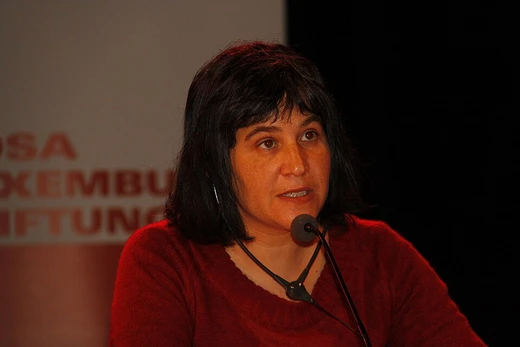
Donna Haraway
American philosopher of feminist technoscience and ecofeminism.
Donna Jeanne Haraway (born September 6, 1944) is an American philosopher whose work bridges information technology, feminist theory, and contemporary ecofeminism. She is known for criticizing anthropocentrism, emphasizing the self-organizing powers of nonhuman processes, and exploring dissonant relations between those processes and cultural practices, rethinking sources of ethics. Her contributions have shaped the study of human–machine and human–animal relations, sparking debate in primatology, philosophy, and developmental biology.
- born
- September 6, 1944
- field
- Philosophy, feminist theory, history of science
- nationality
- American
- known_for
- Cyborg feminism, situated knowledges, critique of anthropocentrism
Lore & Background
Donna Haraway was born in Denver, Colorado, to Frank O. Haraway, a sportswriter, and Dorothy Mcguire Haraway, who died when Haraway was 16. She attended St. Mary's Academy and later Colorado College on a Boettcher Scholarship, majoring in zoology with minors in philosophy and English. After studying evolutionary philosophy and theology in Paris on a Fulbright scholarship, she earned her Ph.D. in biology at Yale University in 1972, writing a dissertation on metaphor in experimental biology, later published as Crystals, Fabrics, and Fields.
Haraway taught women's studies and the history of science at the University of Hawaiʻi (1971–1974) and Johns Hopkins University (1974–1980). In 1980 she joined the University of California, Santa Cruz, becoming the first tenured professor in feminist theory in the United States. She is now professor emerita in the history of consciousness and feminist studies departments there. She lives north of San Francisco with her partner, Rusten Hogness.
Her most famous essay, 'A Manifesto for Cyborgs' (1985), offered a response to rising conservatism and the 'informatics of domination,' using the cyborg metaphor to conjoin contradictions in feminist theory. Her 1988 essay 'Situated Knowledges' exposed the myth of scientific objectivity, arguing that all knowledge comes from positional perspectives. Her book Primate Visions (1989) critically examined primate research through a feminist lens, questioning narratives of gender, race, and nature.
Reader's Guide
Donna Haraway's significance lies in her rethinking of ethics, knowledge, and politics at the intersections of technology, biology, and feminism. Her concept of 'situated knowledges' challenges claims to universal objectivity, insisting that all perspectives are partial and accountable. The 'Cyborg Manifesto' remains a foundational text for understanding how identities and politics are shaped by networked technologies, rejecting rigid binaries in favor of hybrid, contradictory positions. Her work in primatology and the history of science reveals how metaphors and narratives—often gendered and racialized—structure scientific inquiry. Haraway's emphasis on nonhuman processes and dissonant relations with cultural practices has influenced ecofeminism and posthumanist thought. She received the Ludwik Fleck Prize (1999) for Modest_Witness, the Robert K. Merton Award (1992) for Primate Visions, the Wilbur Cross Medal (2017), the Nuevo León Alfonso Reyes Prize (2021), and the Erasmus Prize (2025). Her legacy endures in feminist science studies, philosophy of biology, and critical technology studies.
Did You Know?
- Haraway was the first tenured professor in feminist theory in the United States, at the University of California, Santa Cruz.
- Her dissertation on metaphor in biology was later published as Crystals, Fabrics, and Fields.
- She collaborated with feminist theorist Lynn Randolph from 1990 to 1996, which shaped her book Modest_Witness.
More in Sociologists And Political Theorists 1-22
Spotted an error? Know more?
This is a living reference — every entry is fact-audited, and reader corrections feed straight into our audit queue. Suggest an edit · See this site's audit record