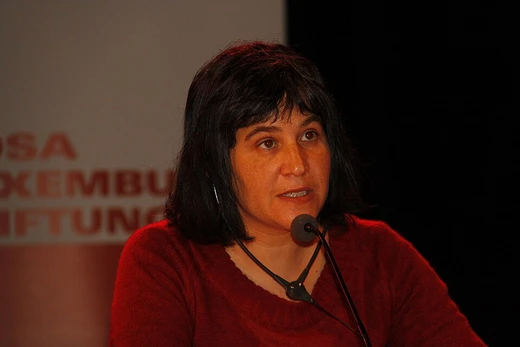
Antonio Negri
Italian autonomist philosopher and co-author of Empire.
Antonio Negri was an Italian political philosopher and a leading theorist of autonomist Marxism. He is best known for co-authoring the influential book *Empire* with Michael Hardt, and for his involvement in left-wing political movements in Italy, including the founding of Potere Operaio and Autonomia Operaia. His life was marked by controversy, including accusations of involvement with the Red Brigades, a period of exile in France, and a prison sentence.
- born
- 1 August 1933
- died
- 16 December 2023
- field
- Political philosophy
- nationality
- Italian
- known_for
- Co-authorship of Empire with Michael Hardt; theorist of autonomism
Lore & Background
Antonio Negri was born in Padua, Italy, in 1933. His father was an active communist militant, and his mother was a teacher. Negri became a communist in 1955 while working at a kibbutz in Israel, and later joined the Italian Communist Party (PCI). He studied philosophy and became a professor at the University of Padua, teaching state and constitutional theory. In 1969, he co-founded the group Potere Operaio (Worker Power) and was a leading member of Autonomia Operaia.
In the late 1970s, Negri was accused of being the mastermind of the Red Brigades, which kidnapped and murdered former Italian prime minister Aldo Moro in 1978. He was arrested on 7 April 1979 and charged with multiple crimes, including the Moro murder. He was acquitted of the Moro murder charge but convicted for other charges including 'insurrection against the state' and 'armed gang'. In 1984 he was sentenced in absentia to 30 years in prison, plus an additional four years for moral responsibility for political violence. The question of his involvement with left-wing extremism remains controversial.
Negri fled to France, where he taught at Paris VIII and the Collège international de philosophie, alongside Jacques Derrida, Michel Foucault, and Gilles Deleuze. In 1997, after a plea-bargain reduced his sentence to 13 years, he returned to Italy to serve the remainder. Many of his most influential books were published while he was in prison. After his release, he lived in Venice and Paris with his partner, philosopher Judith Revel.
Reader's Guide
Antonio Negri's significance lies in his development of autonomist Marxism and his co-authorship of *Empire*, a work that theorized a shift from nation-state imperialism to a globalized, decentralized form of sovereignty called 'Empire.' His writings, including *Multitude: War and Democracy in the Age of Empire* and *Insurgencies: Constituent Power and the Modern State*, have influenced radical political thought, particularly in debates on globalization, democracy, and labor. Negri's life was deeply intertwined with the political turmoil of 1970s Italy, and his legal battles and exile raised questions about the relationship between intellectual work and political activism. While some peers like Michel Foucault defended him as a persecuted intellectual, others, such as Italian President Francesco Cossiga, condemned him. His legacy remains contested, but his theoretical contributions continue to be studied in political philosophy and critical theory.
Did You Know?
- Negri was elected to the Italian legislature in 1983 while still in prison, as a member of the Radical Party.
- He fled to France with the help of Félix Guattari and Amnesty International.
- The caller in the Aldo Moro kidnapping case was later revealed to be Valerio Morucci, not Negri.
- Negri's father died when he was two years old, but his political engagement made Negri familiar with Marxism from an early age.
More in Sociologists And Political Theorists 1-22
Spotted an error? Know more?
This is a living reference — every entry is fact-audited, and reader corrections feed straight into our audit queue. Suggest an edit · See this site's audit record