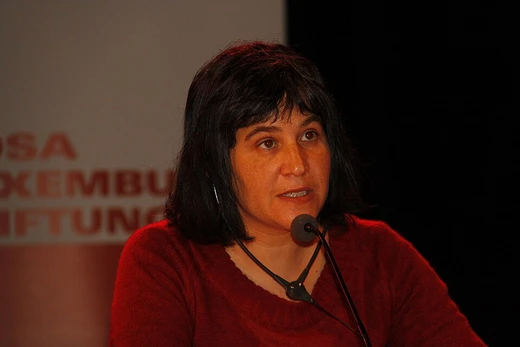
Achille Mbembe
Cameroonian historian and political theorist on colonialism and necropolitics.

Achille Mbembe (born 1957) is a Cameroonian historian and political theorist. He currently works as a Research Professor in History and Political Studies at the University of the Witwatersrand’s Wits Institute for Social and Economic Research in Johannesburg, South Africa. His work focuses on colonialism and its aftermath, and he is considered a key figure in contemporary French critical theory.
Mbembe was born near Otélé, Cameroon. He earned his PhD in history from the University of Paris 1 Panthéon-Sorbonne in 1988 (sometimes cited as 1989), and later completed a DEA in political science at the Institut d'Études Politiques de Paris (Sciences Po) in the same city. Over his career, he has held a series of short-term academic appointments—none lasting more than four years—at institutions including Columbia University, the Brookings Institution, the University of Pennsylvania, the University of California, Berkeley, Yale University, Duke University, and the Council for the Development of Social Science Research in Africa (CODESRIA) in Dakar, Senegal. He was a visiting assistant professor of history at Columbia from 1988 to 1990 (sometimes given as 1988–1991), a senior research fellow at the Brookings Institution from 1991 to 1992, an assistant professor of history at the University of Pennsylvania from 1992 to 1996, and Executive Secretary of CODESRIA from 1996 to 2000. He also served as a visiting professor at Berkeley in 2001 and at Yale in 2003, and was a research professor at Harvard’s W. E. B. Du Bois Research Institute. In 2020, he delivered the presidential lecture in the humanities at Stanford University.
Mbembe has published widely on African history and politics. His book *La naissance du maquis dans le Sud-Cameroun* came out in 1996. *On the Postcolony* was first published in French in Paris in 2000, with an English translation released by the University of California Press in 2001; a new African edition was published by Wits University Press in 2015. He holds an A1 rating from the National Research Foundation.
He is currently a member of the staff at WISER and holds an annual visiting appointment at the Franklin Humanities Institute at Duke University. He also serves as a contributing editor to the journal *Public Culture*.
Mbembe’s main research areas are African history, postcolonial studies, politics, and social science. Though often labeled
- born
- 1957
- field
- History, political theory
- nationality
- Cameroonian
- known_for
- Writings on colonialism and its consequences; leading figure in new wave French critical theory
- current_appointment
- Research Professor in History and Political Studies at Wits Institute for Social and Economic Research, University of the Witwatersrand
Lore & Background
Mbembe was born near Otélé in Cameroon in 1957. He obtained his Ph.D. in history at the University of Paris 1 Panthéon-Sorbonne in 1988 (sometimes cited as 1989), and a D.E.A. in political science at the Institut d'Études Politiques de Paris (Sciences Po) in the same city. He has held appointments at Columbia University, Brookings Institution, University of Pennsylvania, University of California, Berkeley, Yale University, Duke University, and the Council for the Development of Social Science Research in Africa (CODESRIA) in Dakar, Senegal. He was a visiting assistant professor of history at Columbia from 1988 to 1990 (sometimes given as 1988–1991), senior research fellow at Brookings from 1991 to 1992, assistant professor of history at the University of Pennsylvania from 1992 to 1996, and Executive Secretary of CODESRIA from 1996 to 2000.
Reader's Guide
Mbembe's central work, On the Postcolony (2000 in French, 2001 in English), argues that academic and popular discourse on Africa is caught within clichés tied to Western fantasies and fears. Following Frantz Fanon and Sigmund Freud, he holds that this depiction is an unconscious projection tied to guilt, disavowal, and the compulsion to repeat. He interprets Africa not as a defined, isolated place but as a fraught relationship between itself and the rest of the world. Mbembe adds the concept of necropolitics to Michel Foucault's biopower, showing how sovereignty is enacted through the creation of zones of death. He has supported the academic boycott of Israel and compared Israeli practices to South African apartheid, leading to controversy in Germany in 2020 when his keynote address at the Ruhrtriennale was withdrawn after a German official claimed he had relativised the Holocaust and denied Israel's right to exist. Mbembe was supported by groups of Israeli and Jewish academics. He has received the Geschwister-Scholl-Preis (2015), Gerda Henkel Prize (2018), Holberg Prize (2024), and Spinozalens (2025).
Did You Know?
- Mbembe obtained his Ph.D. in history at the University of Sorbonne in Paris in 1989.
- He is married to Sarah Nuttall, director of the Wits Institute for Social and Economic Research.
- His concept of necropolitics goes beyond Foucault's biopower to describe zones of death.
- In 2020, his keynote address at the Ruhrtriennale was withdrawn after a German official accused him of relativising the Holocaust.
The Name Achille: Etymology and Pronunciation
The given name Achille carries a lineage stretching back to ancient Greek mythology, where it was attached to the legendary hero Achilles. In its modern form, the name functions as a masculine given name in both French and Italian linguistic traditions, each rendering it with a distinct phonetic character. The French pronunciation, transcribed as [a.ʃil], gives the name a softer, almost whispered quality, while the Italian rendering [aˈkil.le] introduces a more percussive, two-syllable rhythm. Achille Mbembe, the Cameroonian philosopher and political theorist born in 1957, carries this name as part of his public identity. The name's European linguistic roots stand in notable contrast to his African origin, creating a layered personal identity that spans multiple cultural and linguistic traditions. Among the many individuals who have borne the name Achille across centuries and continents, Mbembe occupies a distinctive position as a thinker working at the intersection of philosophy and political theory.
Cameroonian Identity and a European Name
Achille Mbembe was born in 1957 and is identified as Cameroonian, a fact that places him within the intellectual and cultural landscape of Central Africa. Yet his given name, Achille, belongs to the French and Italian masculine naming traditions, derived ultimately from the Greek mythological hero Achilles. This juxtaposition—a name rooted in European linguistic and mythological heritage carried by a man of Cameroonian origin—reflects the complex cultural intersections that often characterize individuals from regions with layered colonial histories. The name's French pronunciation [a.ʃil] and Italian pronunciation [aˈkil.le] both differ from any Cameroonian linguistic tradition, underscoring the transnational character of his identity. Born in the latter half of the twentieth century, Mbembe entered the world during a period of profound political and social transformation across Africa, and his name itself becomes a small marker of the intertwined histories that shaped the continent's intellectual life.
Philosopher and Political Theorist
Mbembe is described with the dual designation of philosopher and political theorist, a pairing that signals a particular intellectual orientation. Philosophy, in its broadest sense, concerns the systematic examination of fundamental questions about existence, knowledge, and value, while political theory focuses on the structures, principles, and dynamics of governance and collective life. To be identified as both suggests a thinker whose work does not remain confined to abstract contemplation but engages directly with the mechanisms of power, authority, and social organization. Born in 1957, Mbembe's intellectual formation unfolded in a world still redefining its political and philosophical vocabularies. His Cameroonian background further situates his philosophical and political inquiries within a specific geographic and cultural context, bringing particular questions of identity, history, and governance to the fore. The combination of these two fields in a single scholar points to a practice of thought that is simultaneously rigorous in its analytical framework and committed to the concrete realities of political life.
Among the Many Achilles
The name Achille has been borne by a remarkable constellation of individuals across centuries and disciplines. In the visual arts, painters from Achille Beltrame (1871–1945) to Achille Vianelli (1803–1894) carried the name through Italian and French traditions. In music, the most celebrated bearer is undoubtedly Achille-Claude Debussy (1862–1918), the French impressionistic composer and pianist, alongside violinists such as Achille Simonetti and Achille Rivarde. In politics, the name appears in figures ranging from Achille Starace, the Italian fascist leader, to Achille Occhetto and Achille Corona. In science, names like Achille Valenciennes, the French zoologist, and Achille Marie Gaston Floquet, the French mathematician, mark the name's presence in empirical inquiry. Achille Mbembe, the Cameroonian philosopher and political theorist born in 1957, joins this long lineage as a thinker whose work engages the structures of power and the questions of political life, distinguishing his contribution within a name shared by artists, composers, statesmen, and scientists alike.
Frequently Asked Questions
Who is Achille Mbembe?
Achille Mbembe is a Cameroonian historian and political theorist born in 1957 near Otélé, Cameroon. He is widely regarded as a leading voice in contemporary French critical theory, with his scholarship centered on the legacies of colonialism and postcolonial power structures.
What is Achille Mbembe best known for?
He is most celebrated for his writings on colonialism and its long-term consequences, especially his concept of necropolitics, which examines how states wield power over life and death. His work sits at the intersection of history, political theory, and postcolonial studies.
Where does Achille Mbembe currently teach?
He serves as a Research Professor in History and Political Studies at the Wits Institute for Social and Economic Research, part of the University of the Witwatersrand in Johannesburg, South Africa.
What is necropolitics and how does it connect to Mbembe?
Necropolitics is a framework Mbembe developed to describe how modern and colonial states govern populations by deciding who is permitted to live and who is exposed to death. It pushes beyond earlier sovereignty theories by foregrounding the politics of killing rather than merely the politics of life.
Why is Achille Mbembe considered important in political theory?
He is seen as a key figure in the new wave of French critical theory because he reframes colonialism not as a closed historical chapter but as an ongoing structure of power and control. His interdisciplinary blend of history, philosophy, and African intellectual traditions has reshaped how scholars discuss sovereignty, race, and state violence.
More in Sociologists And Political Theorists 1-22
Spotted an error? Know more?
This is a living reference — every entry is fact-audited, and reader corrections feed straight into our audit queue. Suggest an edit · See this site's audit record